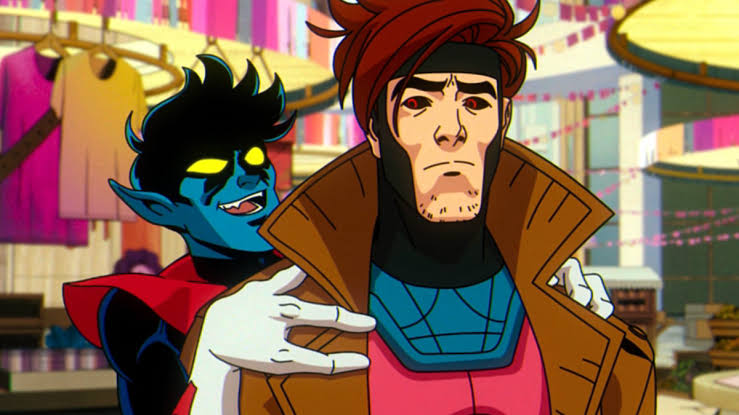
Every comic reader knows the rule. Nobody stays dead. Banshee, Magik, Magneto, and now Nightcrawler are all going to be standing in the mansion kitchen again eventually, and the supervising producer has already teased as much for Kurt Wagner in season 3.
That is fine. Readers can hold that knowledge and still feel something, because the trick has never been convincing the audience that death is permanent. The trick is convincing the characters. And season 2 of X-Men ’97 lost that thread somewhere around the midpoint.
Rogue Solved Death Too Casually
Watch how quickly the team lands on getting Gambit back. There is very little agonizing, very little sense that they are reaching for something that should not be reachable. It reads as a logistics problem. Find the ship, find the Celestial, make the deal.
Rogue has seen this rodeo before, going back to the original animated series, so a certain amount of familiarity tracks. But the show needed at least one character in that room to say out loud that this is impossible, that even if the body comes back the man might not, that they could spend everything and still lose him. Instead the plan comes together fast and clean.
That choice quietly guts the finale. When Nightcrawler trades himself to Eson so Rogue can live, the team has just spent an entire season proving that death is a puzzle with a solution. They know somebody out there does resurrections. They watched one happen. Grieving hard for Kurt would almost be out of character at that point, because by their own recent experience, this is a temporary condition.
Season 1 understood this. Gambit’s death in “Remember It” landed because the world had not yet established a workaround.

The Ending Confirms It
The finale does not give Kurt a funeral. It gives him a montage of mutants living, learning, and making new memories together, and the production team has said that was deliberate, that they wanted something closer to hopeful than mournful. They boarded other versions, including one with an empty chair at the family dinner table.
They picked the warmest option available, and the result is a group of people who just lost a brother sitting around looking mostly okay. If you have decided that resurrection is a solvable problem, the coffee-and-hugs ending is what you get. It is not that the choice was cowardly. It is that the season set the table for it several episodes earlier.
Too Many Plates in Nine Episodes
The other issue is arithmetic. Nine episodes had to carry Apocalypse’s return, Gambit’s resurrection as the Horseman of Death, Magneto’s death, Polaris rejoining the fold, a Wolverine solo arc, X-Factor and X-Force converging on the mansion, Cable’s crusade, and then, in the last stretch, an actual Celestial.
Each of those could have anchored its own run of episodes. Multi-issue comic crossovers get compressed into fractions of an episode here, which makes it nearly impossible to recommend a reading list to anyone who wants the source material. Ten issues of setup for eleven minutes of screen time is a hard sell.
Gambit’s turn is the clearest casualty. One more episode of watching Remy sink under Apocalypse’s control, one more scene of the team admitting they might never get the real him back even if they win, and the finale would have hit twice as hard for free.

The Wolverine Thread Just Stopped
Episode 5, “Weapon X, Lies, and DVDs,” is one of the season’s best. Team X storms a Weapon X facility, the Brood have overrun it, Logan gets infected, and the only cure is a second adamantium bonding. It is a base-under-siege horror episode with Morph as the real POV character, and it kills off Maverick and Garrison Kane on the way through.
It is also the end of that story. Wolverine gets the claws back and the arc closes. In the comics, Logan spent years without adamantium, and that absence drove the man-or-animal question through some of his best material. Here it is resolved in under half an hour, and the hints about what Weapon X was really building never pay off. By the finale, the restored claws do not change the outcome of anything.
Losing a great episode is not the complaint. The complaint is that a great episode turned out to be a cul-de-sac.
Where It Lands
None of this makes season 2 bad. The animation is spectacular, the voice cast is doing career work, the character-focused installments are among the strongest things Marvel Animation has produced, and Nightcrawler finally got the spotlight the original series never gave him. It is still some of the best X-Men content available in any medium right now.
It is an eight. Season 1 was a ten. The gap between those numbers is almost entirely about time and consequence, not craft.
Season 3 arrives on Disney+ in 2027 with Matthew Chauncey running the show, and the post-credits reveal about Mystique and Graydon Creed suggests the next batch is heading somewhere more political and more personal. The best thing that could happen is that the writers make the next loss stick long enough for the characters to sit in it.
Sources: Marvel | SlashFilm | GamesRadar | Den of Geek | Inverse | ComicBookMovie




Leave a comment