
There are plenty of true crime stories that feel like they were built to be a movie, and then there’s Roofman, which somehow feels like it should not work at all on paper. A former Army vet robs fast food restaurants by cutting through roofs, gets caught, escapes prison, and then quietly lives inside a Toys “R” Us like a weird retail phantom. That logline could have turned into a winky comedy, a grim procedural, or a grimier version of a holiday caper. Derek Cianfrance aims for something trickier: a crime story that plays with charm and nostalgia while still carrying a real ache underneath.
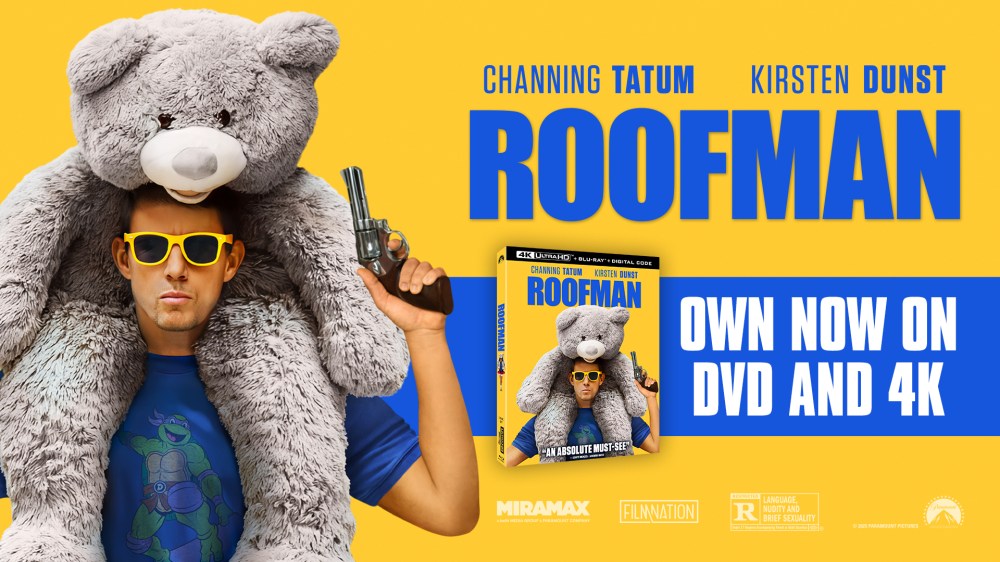
At its best, Roofman is disarming. It lets you laugh at the sheer absurdity of the situation, then turns around and reminds you that the guy at the center of it is not a cartoon. He’s a father with a busted sense of direction, a grown man clinging to the comfort of kid stuff, and a person who keeps choosing the wrong solution because the right one feels out of reach.
What It’s About
Channing Tatum plays Jeffrey Manchester, a struggling father and veteran whose life is stuck in a loop of money problems, bad options, and pride. His robberies become almost routine: pop in from the roof, control the room, take the cash, disappear. The nickname “Roofman” follows him like a myth that the movie is happy to poke at, even when it’s also building him into a sympathetic lead.
After prison, the story takes its most bizarre turn. Jeffrey ends up hiding inside a Toys “R” Us, carving out a secret life among shelves, stockrooms, and surveillance blind spots. This is where the movie’s tone really declares itself. It’s funny in a “how is this real” way, but it’s also quietly sad, because the toy store becomes a stand-in for the childhood Jeffrey can’t let go of, and the stability he never figured out how to build.
Kirsten Dunst’s Leigh enters as the best kind of complication: a person who feels like she exists outside the plot mechanics. Their relationship brings warmth and awkwardness, and it gives Jeffrey something that looks like a normal life, even if it’s built on a lie that can’t hold forever.

Why It Works
The biggest reason Roofman lands is Tatum. He’s got a natural likability that could have turned Jeffrey into a lovable rogue, and the film absolutely uses that. But he also plays the desperation underneath it. Jeffrey isn’t smooth because he’s a genius con man. He’s smooth because he’s learned how to survive moment to moment, and because people want to believe the best version of him.
Dunst is the movie’s secret weapon. Leigh is written with a refreshing amount of adult reality. She’s lonely, she’s blunt, she’s messy, she’s funny, and she doesn’t feel like she exists just to be a moral lesson. The chemistry between her and Tatum does a lot of heavy lifting, because it sells the idea that Jeffrey could almost, almost step into a better life if he’d stop sprinting away from consequences.
Cianfrance also understands the visual hook here. The Toys “R” Us setting could have been a single gag stretched too far, but the movie uses it as a mood. The store becomes this neon-lit sanctuary that’s equal parts comforting and creepy, especially once you realize how easy it is for Jeffrey to disappear inside it. The production design leans into the time capsule feel without making the whole film a nostalgia commercial, and that balance matters.
Where It Stumbles
For all the empathy on display, Roofman sometimes feels more interested in the “what happened next” beats than the harder emotional questions. The movie gives you the charm, the oddball logistics, the romance, and the tension of the chase, but it occasionally skims past the deeper “why” in a way that keeps it from hitting as hard as it wants to.
The tonal juggling can be uneven too. One scene is playing like a breezy caper, the next one wants you to sit with the sadness of Jeffrey’s choices, and not every transition is smooth. That push-pull is part of the film’s identity, and when it clicks it feels honest. When it doesn’t, it can feel like the movie is switching lanes mid-sentence.
Some of the supporting characters also feel like they’re there to keep the plot moving rather than to deepen the world. The cast around Tatum and Dunst is stacked, and the movie gets good mileage out of that energy, but not everyone gets room to breathe.
The Takeaway
Roofman is a strange, sweet, sometimes frustrating movie in the best way. It’s not trying to turn Jeffrey Manchester into a hero, but it also refuses to flatten him into a villain you can dismiss. Instead, it tells a story about a guy who wants grace, wants connection, and keeps sabotaging himself with shortcuts.
If you like crime movies with a little heart and a little bite, and you’re in the mood for something that’s equal parts offbeat and human, this one is worth the time. It’s streaming now and it’s also available on digital, so it’s an easy pick for a night when you want a movie that feels different without being exhausting.








 gfpods.com
Leave a comment