
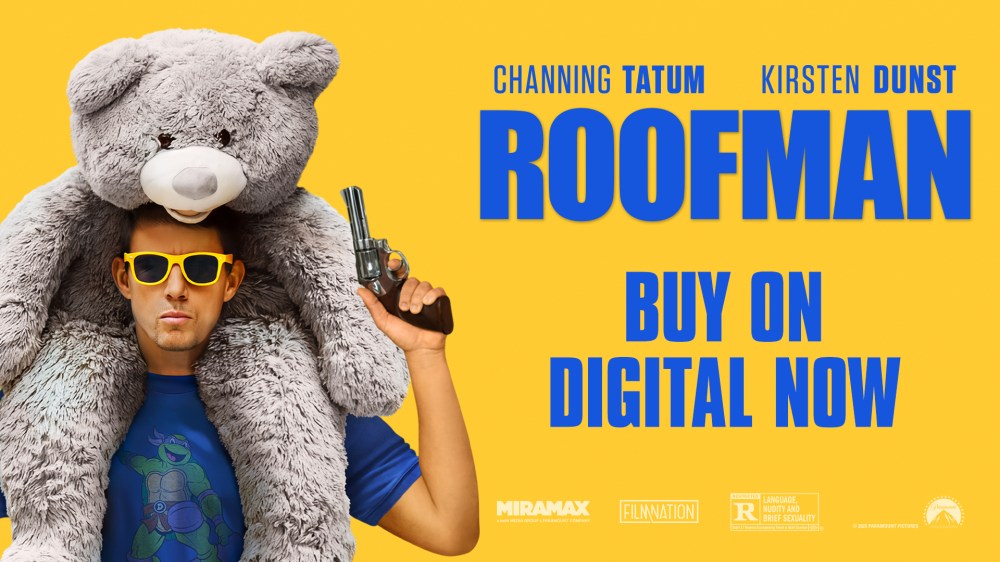
Derek Cianfrance’s Roofman takes a stranger than fiction story and turns it into something that feels surprisingly gentle, even cozy, without losing sight of the damage its main character leaves behind. It is a crime movie about a guy who cuts through McDonald’s roofs and hides out in a Toys “R” Us, but it plays more like a melancholy character study wrapped in a romantic drama.

The film follows Jeffrey Manchester (Channing Tatum), a former Army Ranger and struggling dad who starts robbing fast food joints by literally dropping in through the ceiling. He is oddly polite as he does it, a detail that the movie leans into. After he is caught and sent away, Jeffrey stages a wild escape and disappears inside a Charlotte Toys “R” Us, building himself a hidden life inside the walls. There, under the fake name John Zorn, he drifts into the orbit of Leigh (Kirsten Dunst), a single mom and store employee, and slowly trades the fantasy of a clean getaway for the fantasy of a new family.
What works best is how human the film lets Jeffrey be without turning him into a folk hero. Tatum plays him as a guy who is clever and charming, but not slick. There is a permanent tiredness behind the eyes that keeps reminding you he is running on borrowed time. When he is sneaking through ceiling tiles or rewiring security cameras, there is some of that old heist movie thrill, but Cianfrance always brings it back to the loneliness that drives him.

Kirsten Dunst is the movie’s secret weapon. Leigh is not just “the love interest.” She is a mom juggling lousy shifts, church responsibilities, and two kids who are old enough to see how hard she is fighting. The relationship between Leigh and Jeffrey is where the movie really sings. Their scenes together feel lived in and awkward in the right ways, and when the truth finally starts to close in, Dunst carries a lot of the emotional weight. LaKeith Stanfield, Juno Temple, and Peter Dinklage round out the world around them, giving the story a sense of a real community rather than just a backdrop for the main plot.
Visually, Roofman has a grounded, almost grainy texture that fits the late 90s and early 2000s setting. Shooting in and around Charlotte pays off. The city feels specific, not a random “Anywhere, USA.” The Toys “R” Us sequences are easily the most memorable stretch of the film. Watching Jeffrey roam the store after hours, raid the candy aisles, rig baby monitors, and carve out a hidden “apartment” behind a bike display has a weird childlike wonder to it. It taps into that kid fantasy of being locked in a toy store overnight, then complicates it with the reality that the guy living that fantasy is a wanted felon.
Christopher Bear’s score leans into warm, nostalgic sounds that sit on top of the more anxious crime beats. That mix fits the movie’s tone, which is always walking a line between light and heavy. At times Roofman feels like a throwback to 70s character pieces, at other times like an early 80s crowd pleaser, and that blend mostly works. You get a story that can be sad, funny, and oddly hopeful in the same scene.
Where the film stumbles is in how much it wants to cover in its 126 minute runtime. The first act, with Jeffrey’s string of “Roofman” robberies, is compelling but a little repetitive. You understand the pattern quickly, and the movie is more interesting once he is inside the toy store and entangled with Leigh’s family. There are hints at deeper themes about veterans, class, and how the system boxes people in, but the script does not dig very far into the “why” behind Jeffrey’s choices. It is more interested in the logistics of how he pulls things off and the emotional fallout of his lies than in really interrogating the world that helped shape him.
Even with those gaps, the emotional throughline holds. Jeffrey’s attempts to bond with Leigh’s daughters, his clumsy efforts to be a better man while still planning one more score, and the slow build toward his inevitable exposure all land. When the story reaches its final stretch, the movie finds a bittersweet tone that feels honest to everyone involved. It does not excuse Jeffrey, but it also does not flatten him into a monster.
Roofman ends up as a true crime story that feels more like a strange little hymn to second chances and the ways we sabotage them. It may not fully unpack its own questions, and it could stand to be a bit tighter, but the performances and the offbeat premise make it easy to recommend.







 gfpods.com
Leave a comment