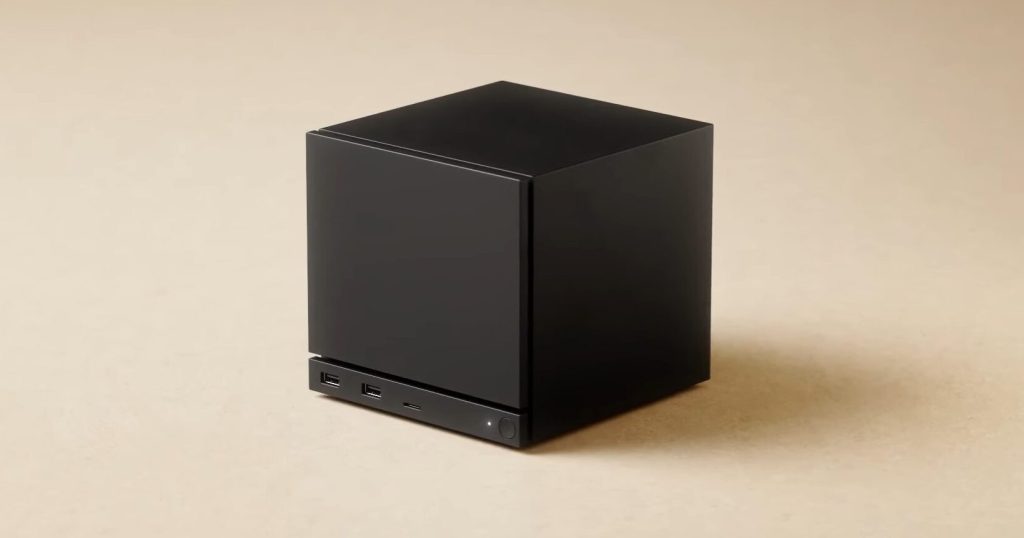
Valve has resurrected the Steam Machine name, and this time it really is a living room console. Announced on November 12, 2025, the new Steam Machine is a compact PC designed to plug into any TV or monitor and run your Steam library, acting as a more powerful, TV-first companion to the Steam Deck rather than a replacement. It is part of a three-piece hardware push alongside the Steam Frame VR headset and a new Steam Controller, signaling that Valve is serious about building a full Steam hardware ecosystem again.
A Tiny Box Built For Your TV
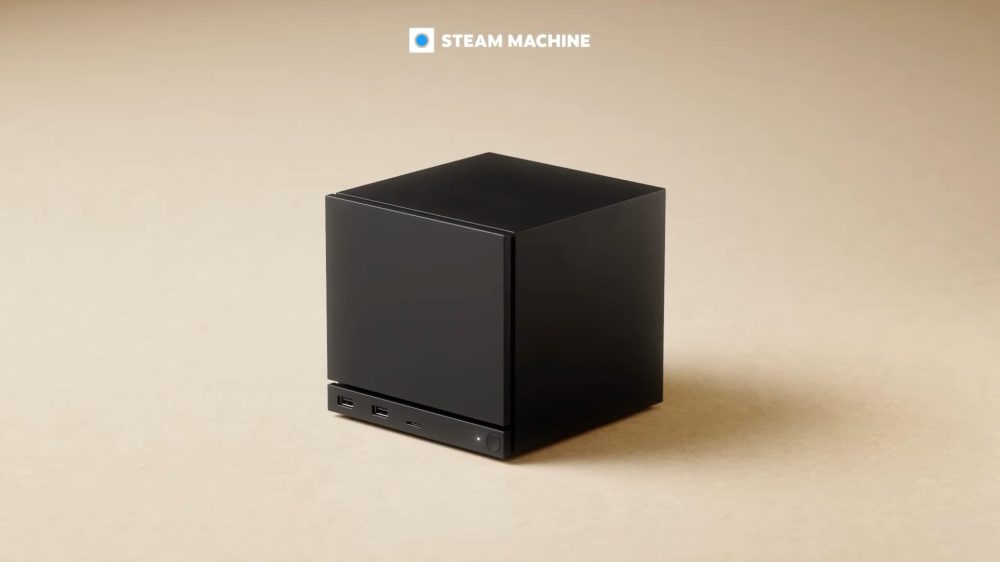
The new Steam Machine is a six inch cube that looks more like a minimalist console than a traditional gaming PC. On the back you get HDMI and DisplayPort for any modern TV or monitor, plus USB ports, Ethernet, and USB-C for peripherals. Inside it runs SteamOS, Valve’s Linux based operating system, using Proton to translate Windows games so they behave as if they are running on a Windows PC. The pitch is simple: drop this next to your TV, sign into Steam, and start playing without worrying about drivers, launchers, or a desktop interface.
Valve is also leaning into the “always ready” angle. Like the Steam Deck, the system is designed to handle game updates, OS patches, and cloud saves in the background so that when you sit down on the couch, your games are already patched and good to go. For anyone used to waiting out giant day-one patches on consoles, that convenience is a big part of the appeal.
Specs That Can Go Toe To Toe With Consoles
Under the hood, this is much closer to a compact gaming PC than a glorified streaming stick. Valve is using a semi custom AMD Zen 4 CPU with six cores and twelve threads, paired with a semi custom RDNA 3 GPU with 28 compute units. The company says the Steam Machine delivers more than six times the performance of a Steam Deck, which puts it in the same general neighborhood as a PlayStation 5 or Xbox Series X, and possibly even ahead in some scenarios.
The base configuration includes 16 GB of DDR5 memory and SSD options at 512 GB and 2 TB, plus a microSD slot for extra storage. RAM and storage are user upgradeable, though the CPU and GPU are soldered and not meant to be swapped, which keeps the box tiny but means this is not a long term custom build platform.
Cooling is handled by a large rear fan that basically takes up the entire back of the case, designed to keep the system quiet in a living room setting. For controls, Valve is positioning the new Steam Controller as the ideal companion, but the Steam Machine also works with standard USB and Bluetooth controllers, keyboards, and mice if you want to treat it like a desktop PC.
More Than A Console: Part Of A Steam Hardware Family
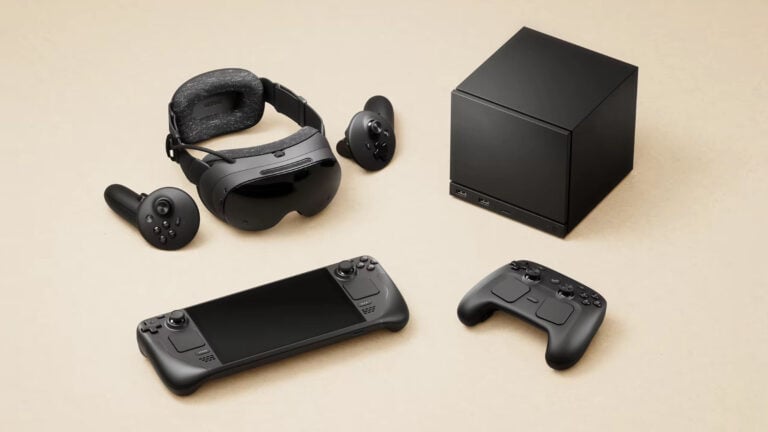
This announcement is not happening in a vacuum. Steam Machine launches alongside the Steam Frame, a new standalone VR headset that can both run games locally and stream PC VR over a low latency 6 GHz link, as well as the new Steam Controller. Together with the Steam Deck, Valve is building a family of devices that can all tap into the same Steam library from different angles.
Valve also plans a “Steam Machine Verified” program similar to Steam Deck Verified, so buyers can see at a glance how well a game is expected to run on the box. On top of that, the machine is powerful enough to stream games out to other devices, including a Steam Deck, Steam Frame, or any gadget running the Steam Link app. In theory, it can be the single beefy PC in your home that powers multiple screens.
Even if you never touch a controller, Valve says you can treat the Steam Machine as a full PC. SteamOS supports installing regular desktop apps or even another operating system, so if you want to plug in a mouse, keyboard, and monitor and use it as a tiny workstation between game sessions, the option is there.
Learning From The First Steam Machines
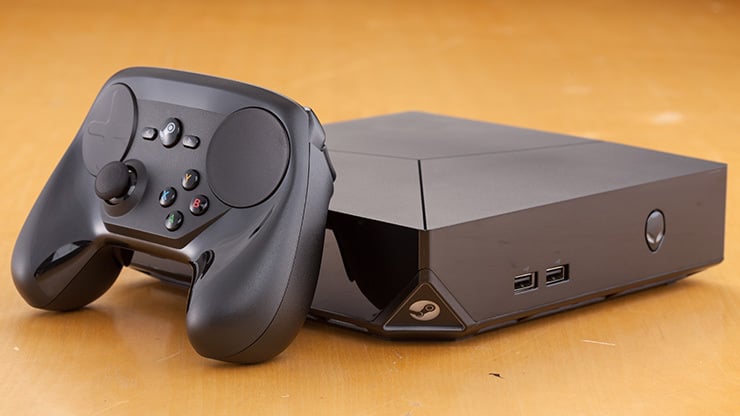
The name “Steam Machine” carries some baggage. A decade ago Valve tried a looser approach, partnering with multiple PC makers to ship a whole range of SteamOS boxes that never quite landed with players. This time Valve is leading with its own hardware and a much more mature software stack. SteamOS is battle tested on the Steam Deck, Proton compatibility has improved dramatically, and players already understand the idea of a console-like PC that boots straight into Steam.
Valve is also being more cautious with partners. The company is open to working with select manufacturers, similar to its partnership with Lenovo on the Legion Go and other projects, but the focus for now is on this single, well defined box. That keeps expectations clearer for players who just want an easy way to plug into a TV and start playing Baldur’s Gate 3 or Elden Ring with minimal setup.
Release Window, Price, And Open Questions
The new Steam Machine is planned for an early 2026 release in all the regions where the Steam Deck is already sold. Valve has not announced pricing yet, but early coverage suggests the company is aiming squarely at the console market rather than ultra high end PC territory. That likely means a price somewhere in the general neighborhood of current PlayStation and Xbox hardware, though global component prices and currency swings will have a say before launch.
There are still questions to answer. We do not yet know how aggressive Valve will be in optimizing games specifically for Steam Machine, how well the Verified program will communicate performance expectations, or how easy it will be for less tech savvy buyers to live inside SteamOS without ever touching a desktop. There is also the long term question of how this box fits into the Steam Deck roadmap, since Valve has said it is not ready to commit to a true Steam Deck 2 yet.
What we do know is that Valve is once again trying to put Steam at the center of the living room. A small cube that hooks up to any TV or monitor, runs your existing PC library, and ties into a growing family of devices is a compelling pitch, especially for players who already live inside Steam. If Valve can nail price, performance, and day one compatibility, the new Steam Machine might finally deliver on the dream that the original version could not quite reach.
Sources:
The Verge, PC Gamer, Video Games Chronicle









 gfpods.com
Leave a comment