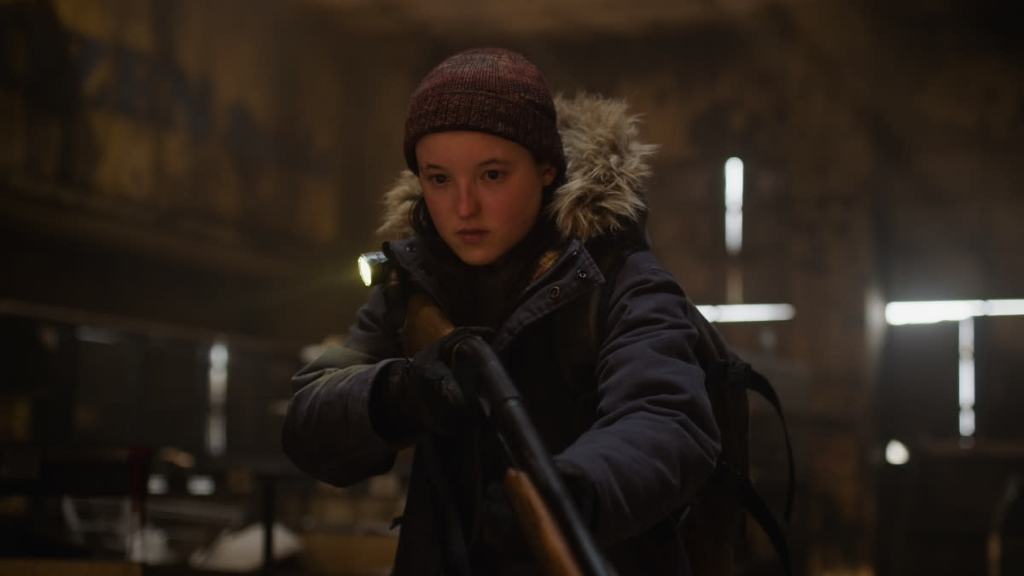
After two long years, The Last of Us returns to HBO for its highly anticipated second season — and just like that, we’re thrust into a world that feels both familiar and freshly scarred. Episode 1 wastes no time reminding us of the weight of its choices, delivering a slow-burn reintroduction to Joel and Ellie, while expanding its world in meaningful ways.
The time jump of roughly five years is felt immediately. Joel and Ellie, once inseparable in their shared struggle for survival, now carry a palpable tension. Pedro Pascal’s Joel wears the burden of his secret like a chain around his neck, and Bella Ramsey’s Ellie — sharp, cold, and visibly distant — senses it too. The chemistry is still there, but it’s twisted, strained by an unspoken truth that gnaws at both of them. As Thomas and Rick put it in the podcast, “You just want Joel to tell her the truth, to clear the air,” but he can’t. And that’s the tragedy.
The episode expertly captures this emotional chasm. It’s not loud or melodramatic; it’s in the silences, the hesitations, and the uncomfortable closeness between them. Even within the seemingly safe walls of Jackson, there’s no real peace for our leads. They’ve found a home, but not belonging.
The new additions to the cast are instantly compelling. Catherine O’Hara brings gravitas and subtle humor as a townsperson who becomes something of a moral compass and voice of the community. As the guys noted, O’Hara’s character feels like “the eyes of the town,” offering perspective and even calling out Joel in a way few dare to. Meanwhile, Ellie’s budding connection with Dina (played charmingly by Isabela Merced) brings moments of levity and youthful awkwardness, adding layers to Ellie’s growth. Their dynamic feels natural, even sweet — Ellie, nervous and overcompensating with jokes, shows a vulnerability that stands out in this bleak world.
Of course, the specter of violence looms large. Abby and her firefly faction are introduced with ominous weight. Caitlin Dever’s portrayal of Abby is already promising, blending steely determination with flashes of buried emotion. There’s a simmering intensity here that hints at future conflicts, and it’s clear she’ll be a force to reckon with this season.
The episode’s pacing is noticeably slower than the adrenaline-charged premiere of Season 1, something the hosts themselves pointed out. But this isn’t a flaw — it feels like intentional table-setting. This is no longer just Joel and Ellie’s story; it’s the story of Jackson, of rival factions, of communities trying to rebuild while ghosts of the past come back with vengeance.
Visually, the episode remains stunning. The creeping threat of the cordyceps, seen spreading through pipes beneath the town, is a clever touch. It’s a quiet yet chilling reminder that the apocalypse is never far, even in moments of calm.
Ultimately, while this premiere may not explode out of the gate, it confidently lays the groundwork for what’s to come. It’s a thoughtful, atmospheric beginning to a season that promises heartbreak, violence, and hard truths. As the hosts said, this feels less like a continuation and more like the start of a new chapter — one that acknowledges the past but isn’t afraid to expand its scope.
Verdict:
A slow but deliberate opening that sets the stage for a season filled with moral gray areas, haunting secrets, and complex character dynamics. Joel and Ellie’s bond is fraying, new characters breathe fresh life into the world, and the storm is clearly on the horizon. The Last of Us is back — and it’s quietly preparing for chaos.
Rating: 8/10



 gfpods.com
Leave a comment