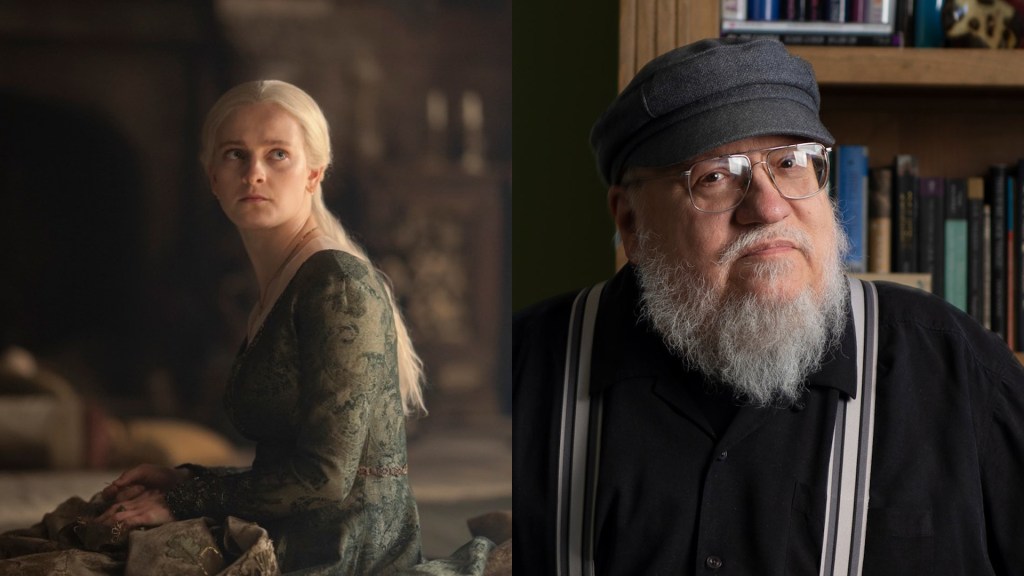
Fans of Game of Thrones and House of the Dragon eagerly awaited George R.R. Martin’s promised blog post, where he planned to address his concerns about the direction of Season 2 of House of the Dragon. When it finally dropped, however, the tone surprised many. Rather than offering nuanced criticism of the production choices or acknowledging the challenges faced by the show’s creators, Martin’s post took aim directly at showrunner Ryan Condal in a way that felt unusually public—and, frankly, petty.
Martin’s blog post, now deleted, focused largely on the exclusion of Prince Maelor, the youngest son of Aegon and Helaena Targaryen, from the House of the Dragon storyline. In the books, Maelor’s death plays a key role in several subsequent plotlines, including Helaena’s suicide and the uprisings that followed. Martin argued that cutting Maelor weakens these future storylines and reduces the emotional weight of the “Blood & Cheese” sequence in the Season 2 premiere. While Martin is undoubtedly passionate about preserving the intricacies of his story, his public airing of grievances raises a question: should he, as the creator, really be engaging with fans on this level?

Martin’s Criticism and Production Challenges
In his blog post, Martin outlined his concern that removing Prince Maelor from the plot will cause ripple effects, impacting not just the current season but future events, including Helaena’s death by suicide and the subsequent riots. He felt the absence of Maelor would strip these moments of their narrative power, weakening the overall story.
While these are valid concerns, it’s also important to consider the context in which House of the Dragon Season 2 was made. Between the ongoing Writers’ Guild of America strike and rumors that the season’s original 10 episodes were reduced at the last minute, the production team likely had little time to adjust their arcs and scripts. Additionally, the budget constraints and complexities of working with young child actors may have played a role in this decision.
It’s understandable for Martin to feel protective of his story, especially since he is so involved in the show’s development. However, criticizing these creative decisions so publicly, rather than addressing them privately with his team, feels out of step with the role he should be playing as the creator.

The Creator as the Grounding Force
As fans, we love discussing changes in adaptations. We dive deep into forums, podcasts, and social media, picking apart the differences between the books and the screen versions. That’s part of the fun of geek culture. However, as the creator, Martin should be a grounding force, not someone who stirs the pot. When he engages in these debates as just another fan, it risks belittling the story he’s worked so hard to create. His involvement should elevate the discussion, providing insight and context for why certain changes might be necessary. By wading into the fray with fans, Martin is reducing his authority and, in some ways, weakening the significance of his story.
Changes That Improve the Story
It’s also worth noting that many changes made in the adaptation of Game of Thrones and House of the Dragon have improved on Martin’s original work. Take the character of Osha in Game of Thrones, for example. The show gave her more agency, a clearer moral compass, and made her a stronger character overall—something Martin later acknowledged and adapted into his books.
The changes to Maelor in House of the Dragon seem minor in comparison. Yes, his absence has some impact on the story, but the ripple effects Martin describes can easily be addressed in future seasons. The show’s writers are skilled enough to work around these changes without compromising the emotional weight of key moments.

In my opinion, the most significant ramification of Maelor’s removal is its effect on Helaena’s suicide. However, the show has already done a much better job developing Helaena’s character than the books did. We see her surviving a brutal marriage, manipulated by her mother, and tormented by her prophetic dragon dreams. Her eventual suicide feels like the tragic culmination of a deeply painful life, and this portrayal is fuller and more realistic than the version in the books, which hinges primarily on the death of her son.
A Collaborative Process
As a fan, I understand the impulse to critique changes in adaptations. Many moments bug me, and I discuss them on my podcast. But that’s part of being a deeply invested fan. It’s what makes geek culture so passionate and vibrant. However, Martin’s role is different—he’s in a position of influence over the adaptation and part of the creative process. The success of House of the Dragon has expanded his world in ways that wouldn’t have been possible without adaptation.
Rather than publicly critiquing the changes, he should work alongside his team to ensure the story stays true to the heart of his vision. Adaptation is inherently collaborative and requires flexibility and trust. Martin’s public criticisms could create unnecessary division between fans and the show’s creators. That friction undermines what could otherwise be an opportunity for growth and evolution in the narrative.
At the end of the day, adaptation is a challenging and complex process, and it will never match the books page for page. But that’s not the goal. House of the Dragon has succeeded by taking the essence of George R.R. Martin’s world and giving it new life on screen, with changes that sometimes enhance the story in meaningful ways. As fans, we’ll always debate and discuss every small deviation—that’s part of the fun. But ultimately, the show’s success is built on collaboration, and it’s worth remembering that every adaptation is its own evolution of the original work.
Sources: Variety, CNN, George RR Martin’s Blog


 gfpods.com
Leave a comment